

Why your door won’t close properly
A door that won’t close is one of those small irritations that gets worse every week. You push it, it springs back, and eventually somebody in the house starts slamming it.
The good news is that most of these jobs are quick and cheap. Nine times out of ten it is a hinge, a latch or a bit of swollen timber, not a broken door.
We deal with this on almost every door installation job we do in Cape Town, so here is the plain version of what we check and in what order.
Quick checks before you fix a door that won’t close
Spend five minutes looking before you reach for tools. Half the time the fault shows itself straight away.
- Open the door halfway and let go. If it swings shut or drifts open on its own, the frame or hinges are out of plumb.
- Look at the gap around the door. It should be more or less even along the top and both sides, roughly the thickness of a R5 coin.
- Push the door slowly towards the frame and watch where it touches first: top corner, latch side, or the floor.
- Hold the handle down and close it. If it shuts perfectly that way, your latch is the problem and not the door itself.
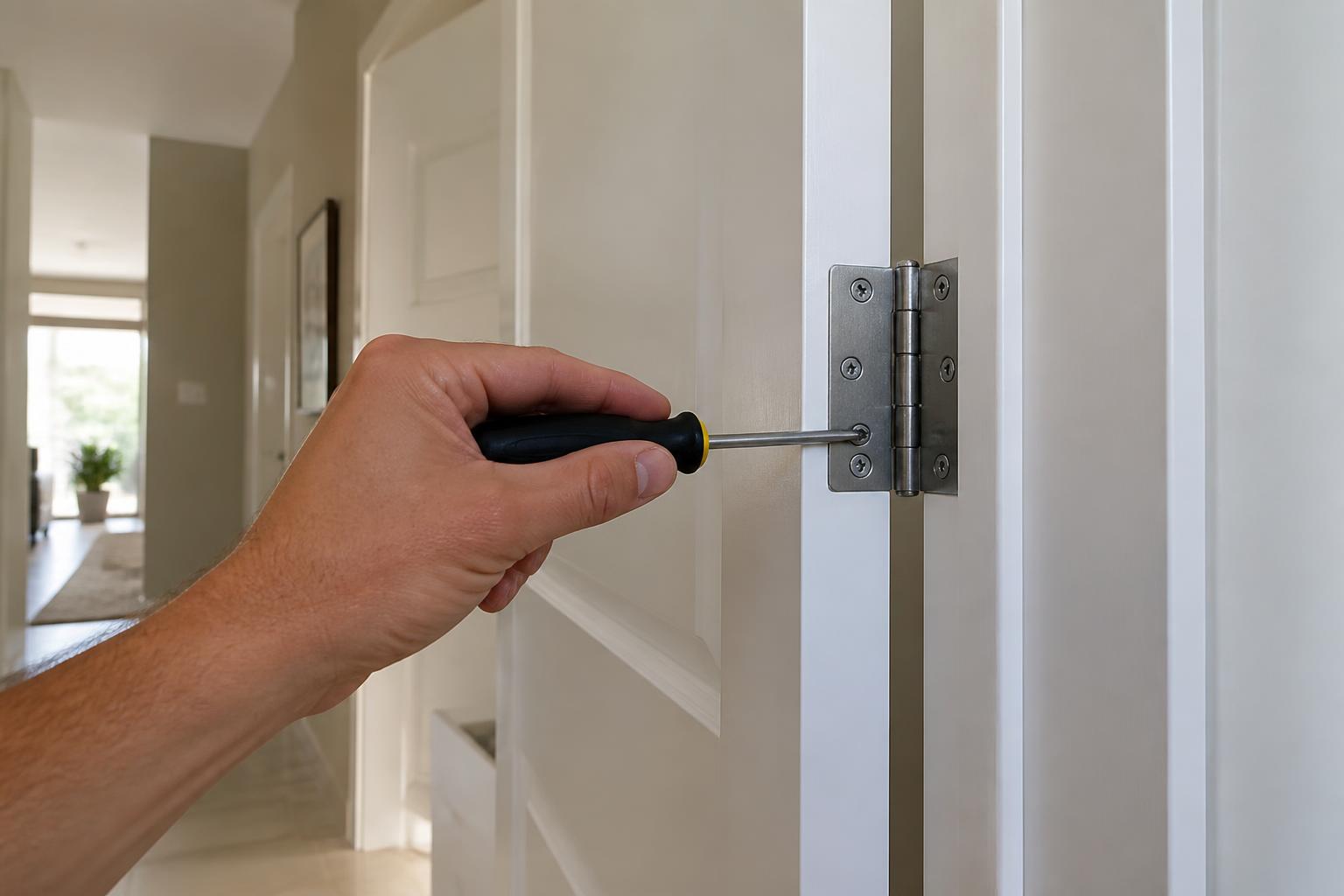
- Put a screwdriver on every hinge screw. Loose screws cause more sticking doors than anything else we see.
The most common reasons a door won’t close
Loose hinge screws
Hinges carry the whole weight of the door on six or eight small screws. Over the years those screws work loose in the frame and the door sags towards the handle side.
You will usually see it as a gap that is tight at the top corner and wide at the bottom. Tightening the screws often solves it in two minutes.
Swollen timber in a wet Cape Town winter
Solid timber and unsealed edges take in moisture. In June and July we get calls from Kenilworth, Bellville and Table View about doors that were fine in summer.
If the door binds only in winter, the fix is usually a light shave on the sticking edge plus a coat of sealer on the raw timber.
The latch misses the strike plate
Here the door closes flush but does not click, or it clicks and then pops open. The tongue is landing on the metal plate instead of going into the hole.
Look for a shiny scratch mark on the strike plate. That mark tells you exactly which way the plate needs to move.
The house has moved
Older Cape Town homes settle, and doorframes go slightly out of square with them. You cannot fix the house, but you can usually re-hang the door to suit the frame it lives in now.
How to fix a door that won’t close: step by step
Work through these in order. Stop as soon as the door closes properly, because each step gets a bit more involved than the last.
- Tighten every hinge screw. If a screw spins without biting, take it out, push wood glue and a few matchsticks or a piece of dowel into the hole, let it dry and screw it back.
- Swap the middle screw on the top hinge for a longer 60mm or 75mm screw so it reaches the frame timber behind. This alone lifts a sagging door surprisingly well.
- Clean and lubricate the hinges and the latch with a little silicone spray. Old paint and grit make a latch stiff.
- Adjust the strike plate. Undo it, move it 2mm or 3mm in the direction of the scratch mark, drill new pilot holes and screw it back.
- If the plate cannot move far enough, file the opening slightly bigger with a small round file. Neat and slow beats fast and rough.
- Only if the door still binds, mark the tight spot in pencil, take the door off and plane or sand that edge back a couple of millimetres.
- Seal any bare timber you exposed, then re-hang and test the swing before you paint.
Quick tip from our installers
Never plane a door before you have tightened the hinges. We have seen plenty of doors shaved down in winter that ended up with a big ugly gap by January, once the timber dried out and the hinges were finally sorted.
When a door won’t close because the frame is out of square
Sometimes the door is perfect and the frame is the problem. Hold a spirit level against the hinge side of the frame and check it top to bottom.
If the frame is out by more than a few millimetres, packing the hinges is the usual answer. A thin piece of cardboard or a plastic shim behind one hinge leaf changes the angle the door hangs at.
- Packing behind the top hinge pushes the top of the door away from the frame.
- Packing behind the bottom hinge tilts the door the other way.
- Deepening a hinge recess by a millimetre does the opposite of packing it.
Work in small amounts and test after every change. It is fiddly, but it saves buying a new door.
What it costs to sort out a door that won’t close
Prices depend on the door, the suburb and how far the problem has gone. These are honest ballpark ranges, not quotes.
- Basic call-out with hinge tightening and a strike plate adjustment: usually a small once-off labour charge, often under R750.
- Re-hanging a door with new hinges: generally somewhere in the R900 to R1,800 range including hardware.
- Planing, sealing and re-hanging a swollen solid door: often R1,200 to R2,500 depending on size.
- New interior door supplied and hung: usually starts around R1,500 and climbs with the door you choose.
If you are weighing up repair against replacement, our guide to interior door types and prices lays out what each kind of door costs. There is also a full breakdown in our door installation cost guide.
When to replace instead of fixing a door that won’t close
Repairing is almost always the cheaper route. There are a few times when it is throwing money away though.
- The door is delaminating or the hollow core has broken open around the latch.
- Rot has softened the bottom rail, usually on doors near a bathroom or a leaking gutter.
- The door has been planed so many times that the gaps look terrible even when it closes.
- You are changing the lock anyway and the existing door is a cheap hollow one on a bedroom you want secure.
In that last case it is worth reading up on choosing locks for your home before you buy, because the door and the lock need to suit each other.
Get us to look at it
If you have tried the hinges and the strike plate and the door still fights you, give us a shout. Send us a photo of the gap through our contact page and we will tell you honestly whether it is a quick fix or a re-hang.